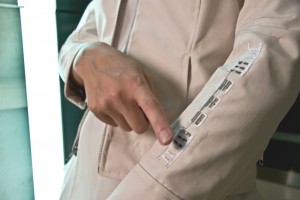
The MMT Therapeutic glove is designed to be easy to wear for a person with limited sensation and dexterity. The glove is used passively. It teaches the wearer the “muscle memory” of a song by vibrating the correct fingers in time to a song
as the user performs daily tasks. Our studies show that learning and rehabilitation effects occur with or without the audio of the song. The glove provided is programmed to teach Beethoven’s “Ode to Joy.”
Mobile Music Touch Therapeutic Motivation
“Can I learn to play piano without having to practice?” To answer this question, we created a glove called the Mobile Music Touch (MMT). MMT vibrates the user’s fingers in the order and rhythm of how a song is played on a piano while the user is engaged with other tasks, such as reading email or watching television. In time, the user learns the “muscle memory” of the song without focusing attention on the glove. We call this concept “passive haptic learning” (PHL). In our university research at the Georgia Institute of Technology, we have published several studies that have confirmed this effect.
During a demonstration of a MMT prototype, the Shepherd Center, a world-renowned spinal cord injury rehabilitation center, became interested in how the project might help rehabilitation. In current medical practice, rehabilitation is considered to have little effect after a year past injury, and insurance rarely pays for continued rehabilitation past this point. Our study recruited patients with tetraplegia due to a partial spinal cord injury over this year threshold. All our participants improved sensation in their hands significantly through using MMT. One study participant even regained the ability to type with multiple fingers; another could button his own shirt again.
Using the principles of iterative design in collaboration with Shepherd Center patients, we have created MMT Therapeutic, a glove designed to be compatible with the everyday lives of those with limited hand sensation and dexterity. The glove is an inexpensive and non-invasive way to provide rehabilitation effects during a user’s everyday life. While other rehab techniques are often abandoned, MMT participants learn a fun new life skill, playing piano, which encourages them to continue therapy on their own.

Glove Design
The MMT Therapeutic glove is designed to be easy to wear for a person with limited sensation and dexterity. The glove is used passively. It teaches the wearer the “muscle memory” of a song by vibrating the correct fingers in time to a song as the user performs daily tasks. Our studies show that learning and rehabilitation effects occur with or without the audio of the song. The glove provided is programmed to teach Beethoven’s “Ode to Joy.”

How it works
Unlike our studies on passive haptic learning (where the goal is to show a learning effect without active attention) our user studies on passive haptic rehabilitation (PHR) begin with a session of active learning. The user wears the MMT Therapeutic glove and learns to play a song in front of a piano keyboard. The piano keys light as each note is played, helping the participant learn the song. The active learning session occurs 3 times a week for 30 minutes a day.
After the active learning session, the user enters the passive haptic learning phase. During this phase the user wears the MMT Therapeutic glove for a period of a least 2 hours a day, 5 days a week. The user wears the glove while performing normal daily routines and tasks. During the day the MMT Therapeutic glove uses its vibration motors to stimulate the individual fingers in the order and rhythm of the song the user is attempting to learn. The participants learn one song a week for 8 weeks.
Using the Semmes-Weinstein monofilament test, we compared the improvement in hand sensation for participants who used the glove versus those who only performed active piano learning sessions. Participants who used the glove showed improved sensation on all 8 sites we tested on their hands, whereas those who did not use the glove showed little effect. All participants were a year past injury, a time when significant rehabilitation improvements are considered unlikely and medical coverage for continued rehabilitative care is rare.

The MMT Therapeutic Design Team
Thad Starner
Professor
School of Interactive Computing
Georgia Institute of Technology
Ellen Do
Professor
Core Faculty at the Health System Institute
Georgia Institute of Technology
LTC Tanya Markow
Assistant Professor
Department of Electrical Engineering and Computer Science
United States Military Academy West Point
Deborah Backus
Director of MS Research
MS Institute at Shepherd Center
Scott Gilliland
Peter Presti
Research Scientist
School of Interactive Computing / Interactive Media Technology Center
Georgia Institute of Technology
Clint Zeagler
Research Scientist
School of Industrial Design
Georgia Institute of Technology
David Quigley
Halley Profita
Kevin Huang
Daniel Kohlsdorf
Graduate Research Assistants
Georgia Institute of Technology